
Variloom: On-Demand 3D-Printed Clothing Reduces Waste and Costs
Variloom, based in Palo Alto, California, has developed a 3D printing-to-shape system and accompanying recyclable soft materials, enabling brands to design and produce customized, recyclable fabrics within days rather than months. The technology aims to reduce material waste, lower excess inventory, and lessen reliance on offshore manufacturing. The company's risk lead, Bethany Meuleners, discusses in an interview the technology's principles, collaboration progress, and industry application prospects.
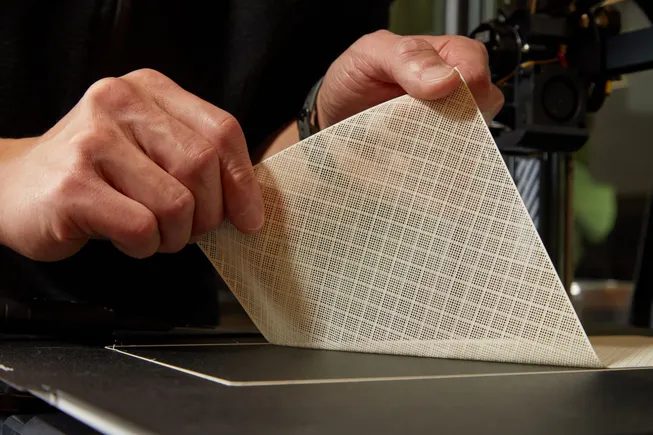
Variloom's printing filaments and 3D printing system are designed for customized, high-efficiency manufacturing of versatile and recyclable fabrics. Its on-demand, on-site 3D printing-to-shape technology enables brands to design and produce customizable, recyclable fabrics in days rather than months, reducing waste, minimizing excess inventory, and decreasing reliance on offshore manufacturing.

Additionally, the proprietary soft materials from this Palo Alto, California-based company, made from bio-based thermoplastic polyurethane and natural textile waste, can be tailored with performance features such as moisture-wicking or odor control. These materials are suitable for a range of products from shirts and pants to handbags and footwear, and can be recycled up to three times without loss of quality.
Bethany Meuleners is a designer with twenty years of experience in apparel, footwear, accessories, and textile design. Before serving as venture lead at Variloom, she co-founded the contemporary women's knitwear brand Mansoor Scott and held leadership roles at Betabrand, The Comfy, and Stella & Dot.
Meuleners recently spoke with Manufacturing Dive about Variloom and how 3D printing will transform apparel manufacturing—including her vision of a future where physical retail customers can receive custom products while they wait in-store.
This interview has been edited for clarity and brevity.
Manufacturing Dive: How did you come to join Variloom? What is the company's overall mission?
Bethany Meuleners:I have worked in the fashion industry for over 20 years, primarily in product design, product development, and product strategy. I have helped companies from startups to large enterprises launch products, apparel, and product programs, so I have seen the supply chain from multiple angles. I have personally experienced the inefficiencies, waste, and other issues in the industry. The problems Variloom aims to solve—overproduction, long lead times, and offshore manufacturing—are ones I deeply understand.
At our core, we are rethinking how materials and products are made in the soft goods and fashion space. We have built a 3D printing-to-shape system and developed proprietary recyclable materials that work with it. The idea is that brands and suppliers can produce customizable fabrics on demand and on site in a much shorter time frame—days rather than months. Traditional fashion supply chains typically run on cycles of three months to a year, with product decisions made even earlier, which can lead to overproduction and misjudging fashion trends.
The system we are building is a direct response to this problem. We are creating a new supply chain that integrates 3D printing and additive manufacturing, and we are working with brands and suppliers. Our publicly announced partners include YKK and Rip Curl, along with some supply chain collaborations. We are focused on scaling the technology with these partners and continuing to deepen our work in apparel.
What types of products are you currently producing? What areas do you plan to expand into in the future?
We are currently focusing on components and parts rather than completely overhauling entire products. The significance is that brands can achieve customization and design details that are not possible with traditional methods and typically require very large volumes. For example, we are producing customizable zipper pulls for YKK. For Rip Curl, we have designed and developed components specifically for their boardshorts to help solve issues surfers face, such as shorts riding up. At the same time, we are continuously exploring the boundaries of large-format printing and are gradually moving into the manufacturing of entire garments and full products.
What we truly focus on is building the system and materials, then partnering with brands and suppliers. We prefer to first understand the problems they are trying to solve and the end products they want to make, then think about how we can not only create great products for them but also use our system and materials to solve that problem in a way that adds value. With 3D printing, we can achieve targeted structural design, build items layer by layer, and introduce added value in ways unique to our system.
Currently, we work with brands and suppliers to produce products that meet their brand-specific requirements. But ultimately—and I think this will happen within the next few years—customers will be able to walk into a store, pick out a product, and have it customized and made for them while they wait. While we cannot do this today, we certainly will in the near future.
How does your 3D printing process significantly reduce production time?
Stepping back, what we really want to do is study how to improve and integrate into the existing apparel manufacturing system rather than completely overturning everything. So, in the early stages, we concentrated on developing proprietary materials that can truly become a customizable, printable wearable material. Because when most people think of 3D printing, they think of harder objects.
And it is not just about achieving flexibility—what is more critical is creating products people actually want to wear. So we have not completely reinvented or disrupted 3D printing technology. We deliberately developed a material that can work with existing printing systems, and then we continuously improve through our software, components, and how the material interacts with these systems.
Wouldn't 3D printing take longer than traditional manufacturing because custom products need to be printed one by one?
Looking back at the development of 3D printing over the past decade, print speed has made and will continue to make great strides in terms of throughput, but that is only part of the problem. Our angle is this: traditional manufacturing may be fast on the production line, but it also means producing tens of thousands or even hundreds of thousands of items. When you factor in the full timeline—including design finalization, sourcing, overseas shipping, customs clearance, and distribution—it often takes months for products to truly reach consumers.
By producing on demand closer to the consumer, you can compress the entire cycle and eliminate many of these steps. So, even as we continue to increase throughput, and even if the production time per item is slightly longer than traditional methods, the advantage in customer-facing delivery time enables better planning, better customer engagement, and creates more opportunities for customization.
At this stage, we are not trying to replace the processes of companies producing 100,000 items. We want to enable higher levels of decision-making and product customization closer to the point of sale. The problems of overproduction and fast fashion occur precisely in the mass-production sector. And that model of producing thousands of items stems from the traditional textile industry—you have to buy thousands or even tens of thousands of meters of fabric to make a difference.
Imagine if you could remove that step from the equation—materials themselves can be developed for customer needs, with more stretch, or made stronger, or with custom details—things that are not possible with traditional materials due to volume constraints. I believe consumers are eager for more connection with the products they buy and consume.
Compared to traditional manufacturing, have you quantified how much apparel companies can save through on-demand 3D printing?
We are building a calculation tool to show the money and time that can be saved per product. But overall, in traditional cut-and-sew manufacturing, the cutting process alone wastes about 15% of materials. So, if a company spends $100,000 on textiles, about $15,000 of that is essentially wasted in cutting room scraps. Adopting a print-to-shape solution can reduce this waste and bring cost savings.
What do you see as the remaining barriers to broader adoption of 3D printing technology in the apparel industry?
I think many brands have very entrenched supply chain systems that have been in place for a long time, so any change—because it does require change—in how products are designed and delivered to consumers can be challenging. Also, every business has margin requirements and delivery deadlines that must be met.
So, I think the key is finding the right people and organizations that are truly willing to drive innovation and run pilot tests to prove that moving away from traditional supply chains and methods can actually open up new opportunities rather than disrupt their normal cycles. It is partly an educational process, and it also requires finding the right participants to test these pilots and prove their viability.
We have already gained a lot of attention and are in conversations with some very talented innovators, designers, and product leaders who see the future we envision. We are very excited about that.