
FDA traces WanaBana lead contamination incident to a single cinnamon processor in Ecuador
Last fall, children in multiple U.S. states developed lead poisoning symptoms after consuming applesauce from brands such as WanaBana. An FDA investigation found that the source of contamination pointed to Ecuadorian cinnamon processor Carlos Aguilera, whose supplied cinnamon was contaminated with lead during processing. The incident exposed limitations in the FDA's oversight of overseas supply chains and prompted the agency to consider strengthening related testing and inspections.
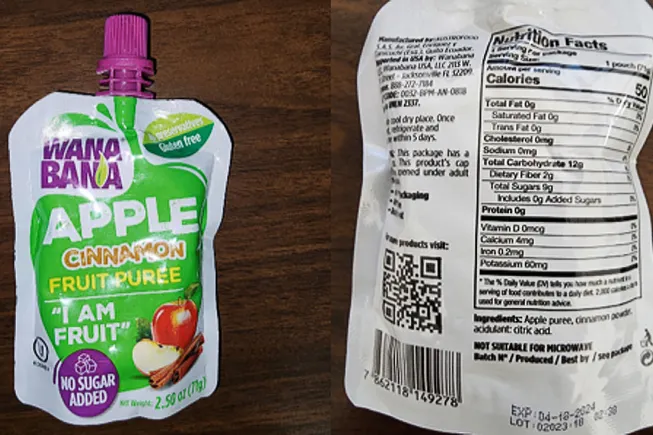
Last fall, dozens of children across the United States began experiencing symptoms such as headaches, nausea, anemia, and fatigue. Parents were shocked to discover that the applesauce pouches their children consumed daily had caused lead poisoning.
On October 31, WanaBana USA, the popular applesauce pouch manufacturer, voluntarily recalled all of its apple cinnamon fruit puree productsdue to elevated lead levels found in some of its products.。
The recall ultimately covered three brands—WanaBana, Schnucks, and Weis—all produced by food manufacturer Austrofoods. According to data from the U.S. Centers for Disease Control and Prevention (CDC), as of February 9, these products had caused 422 cases of lead poisoning across 44 states.

In the months since the initial voluntary recall, the U.S. Food and Drug Administration (FDA) has traced the contamination to a facility in Ecuador that produced the puree. On February 6, the agency announced that Ecuadorian officials identified a cinnamon processor in that country as the likelysource of contamination。
The FDA's months-long investigation not only involved infant food production practices and supply chain issues, but also revealed the agency's challenges in regulating overseas facilities that supply the U.S. market.
Timeline of contamination
WanaBana's voluntary recall initially stemmed from reports in October from the North Carolina Department of Health and Human Services and the North Carolina Department of Agriculture and Consumer Services regardingelevated blood lead levels in four children. At the time of the recall, WanaBana said it was working to determine the source of contamination.
On November 9, two additional products were recalled: Schnucks apple cinnamon fruit puree pouches and Weis cinnamon applesauce, both produced by WanaBana USA.
On November 16, the FDA tested WanaBana applesauce pouches collected from Dollar Tree stores and found lead levels more than 200 times higher thanwhat the FDA considers safe for infant and toddler purees and similar products.
Subsequently, on December 5, the FDA conducted an on-site inspection of the Austrofoods facility in Ecuador that produced WanaBana products. According to itsLinkedInprofile, Austrofoods was founded in 2008 and has only one facility located in Pichincha Province, Ecuador.
The agency also investigated Negasmart, an Ecuadorian third-party distribution company responsible for supplying cinnamon to Austrofoods.
According to a notice dated January 5, 2024, the FDA also discovered chromium in the fruit puree pouches while testing the recalled products and cinnamon.
According to the U.S. Centers for Disease Control and Prevention,both lead and chromium are toxic at elevated levels, especially for children.
On February 6, Ecuadorian officials identified cinnamon processing company Carlos Aguilera as the "likely source of contamination" for the fruit puree pouches. Carlos Aguilera sourced cinnamon sticks from Sri Lanka, which, according to Ecuadorian officials, were not contaminated with lead before processing.
According to the FDA's February 6 update, Carlos Aguilera is currently not in operation.
However, the FDA has limited authority to intervene with the foreign suppliers and manufacturers involved in this incident because Negasmart and Carlos Aguilera did not ship directly to the U.S., and their products underwent further processing before export, the agency stated in the update.
WanaBana did not respond to requests for comment.
What does this case mean for U.S. food production?
The FDA confirmed it is exploring a theory that the cinnamon contamination may have been the result of economically motivated adulteration. According to the agency, such incidents refer to cases where someone intentionally omits, removes, or substitutes valuable ingredients or parts of a food product.
"The current elevated lead levels in cinnamon applesauce pouches are highly unusual," an FDA spokesperson told Manufacturing Dive in an email.
Because the lead levels far exceeded the FDA's draft guidance and could pose health risks, these products are considered adulterated under the Federal Food, Drug, and Cosmetic Act, the spokesperson added.
Every step in the infant food production process is highly monitored by the FDA. The spokesperson stated that manufacturers of infant and toddler foods must implement controls to test for toxins such as arsenic, cadmium, lead, chromium, or mercury to significantly reduce or prevent any chemical hazards from entering their products.
The FDA also launched the"Closer to Zero" initiativein 2021, focusing on research, regulation, and consultation to help reduce children's exposure to these contaminants. In January 2023, the agency proposed setting new, lower action levels for contaminants in fruits, vegetables, and other foods.A draft action level of 10 parts per billion (ppb) or lowerwould apply to fruit puree pouches like WanaBana products.
FDA found WanaBana cinnamon apple pouches had lead levels 200 times higher than guideline allows
However, some experts believe the initiative is insufficient, such as Jane Houlihan, research director at the food safety advocacy group Healthy Babies Bright Futures. Houlihan noted that the FDA's proposed action levels for lead in baby food would only reduce dietary lead exposure for infants and toddlers by 3% to 4%. This is because the FDA's data does not include infant formula, ingredients for homemade baby food, and other store-bought foods, the advocacy group said.
"We want the FDA to set more health-protective action levels," Houlihan said. "The standards they set are easy for the industry to meet but don't provide much benefit to infant health, and their priorities in the 'Closer to Zero' initiative are misaligned."
"We want the FDA to set more health-protective action levels. The standards they set are easy for the industry to meet but don't provide much benefit to infant health, and their priorities in the 'Closer to Zero' initiative are misaligned."
——Jane Houlihan, Research Director at Healthy Babies Bright Futures
Due to the current lack of regulation, Houlihan said manufacturers only need to comply with their own internal standards, leaving room for elevated contaminant levels.
"We hope they will truly strengthen the program in a meaningful way and take more actions that have downstream benefits for infants," Houlihan said. "Setting action levels involves a lot of bureaucratic process and scientific analysis, and it's disappointing that the first major action level from the program—the lead action level—has such minimal benefit to children's health."
She would like to see mandatory federal testing of suppliers' ingredients and finished products.
"Most baby food companies want to sell food that is healthy for babies. So, if there are federal guidance levels, they would be interested in paying attention to them," Houlihan said.
Due to the recent WanaBana investigation, the FDA expects to conduct additional testing of cinnamon and cinnamon-containing foods consumed by infants and toddlers, the agency spokesperson said. The agency will examine samples collected from domestic and foreign facilities and consider more inspections of facilities that use cinnamon as an ingredient in finished products.
Both domestic and foreign manufacturers have a responsibility to ensure that products entering the U.S. market are safe, the spokesperson added.
"The FDA maintains consistent vigilance over the food supply," the spokesperson said. "Based on the information obtained from this investigation, we expect to continue inspecting other businesses and conducting investigations to ensure similar incidents do not occur again."