
U.S. Steel becomes growth engine one year after Nippon Steel acquisition
One year after Nippon Steel acquired U.S. Steel, the latter has become the group's growth engine. Latest quarterly data shows U.S. Steel contributed 32.2 billion yen in base business profits, accounting for nearly 30% of the group; the company raised its fiscal 2026 profit guidance for U.S. Steel to 180 billion yen and plans to invest $11 billion in the U.S. by 2028.
At a Glance
- Since completing the acquisition last summer, U.S. Steel has become a major growth engine for Nippon Steel. In the last quarter, higher domestic steel prices and operational improvements partially offset the impact of weak overseas demand and uncertainty in the Middle East market.
- In the three months ended June 30, U.S. Steel posted underlying business profit of 32.2 billion yen (about $204.5 million), accounting for nearly 30% of Nippon Steel's underlying business profit. The segment is expected to continue driving earnings growth into next year.
- On Tuesday, Nippon Steel raised its fiscal 2026 business profit guidance for U.S. Steel to 180 billion yen (about $1.14 billion) from the previous 1 trillion yen. The company said the revision reflects the full benefits of the blast furnace restart and the recovery of the U.S. market.
In-Depth Analysis
Nippon Steel's bet on the U.S. steel market is beginning to pay off.
After recording an underlying business loss of 5.6 billion yen (about $35.5 million) from U.S. Steel in fiscal 2025, recent earnings have rebounded as the market recovers—U.S. tariffs have pushed up steel prices and demand remains stable.
These factors offset the challenges Nippon Steel faced in the quarter, including higher raw material and fuel costs and a decline in steel exports to the Middle East—which the company said has begun to affect its Japanese operations.
Nippon Steel reported revenue of 2.8 trillion yen (about $17.94 billion), up 40.4% year-on-year, driven mainly by its steel manufacturing and processing businesses; business profit rose 50% to 145.5 billion yen (about $924.7 million).
The company also posted underlying business profit of 108.4 billion yen (about $688.7 million), down from 173.6 billion yen in the same period last year. Underlying business profit excludes inventory valuation effects and is considered by Nippon Steel to be a more accurate earnings indicator.
Despite cost and export challenges, the company remains optimistic about its full-year guidance, driven mainly by investments in Europe and the United States. Nippon Steel raised its full-year underlying business profit forecast to more than 700 billion yen (about $4.45 billion), up from 650.4 billion yen last year, and cited U.S. Steel as a key growth engine.
According to the earnings release, Nippon Steel plans to invest $11 billion in the United States by the end of 2028, focusing on enhancing U.S. Steel's capacity, energy efficiency, productivity, and quality. This commitment is a key part of the $14.9 billion acquisition of U.S. Steel approved in June 2025.
As of August 4, the company has invested $3.7 billion of its multi-year target. As planned, a blast furnace at the Gary Works in Indiana will complete major maintenance by the end of August, and the hot strip mill will complete upgrades by the end of September.
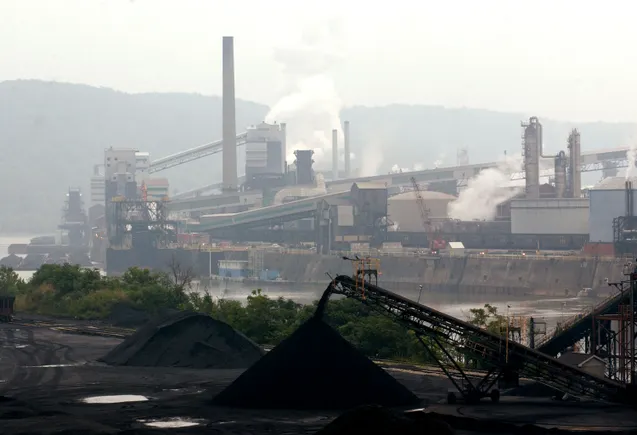
Nippon Steel is also building a direct reduced iron plant in Osceola, Arkansas, and installing a slag recovery unit and hot strip line at U.S. Steel's Mon Valley Works in Pennsylvania. Recently, the company also began expanding an existing quench-and-temper line in Fairfield, Alabama.