
Drone Manufacturer Powerus: Breaking Through Capacity Constraints Through Supply Chain Restructuring
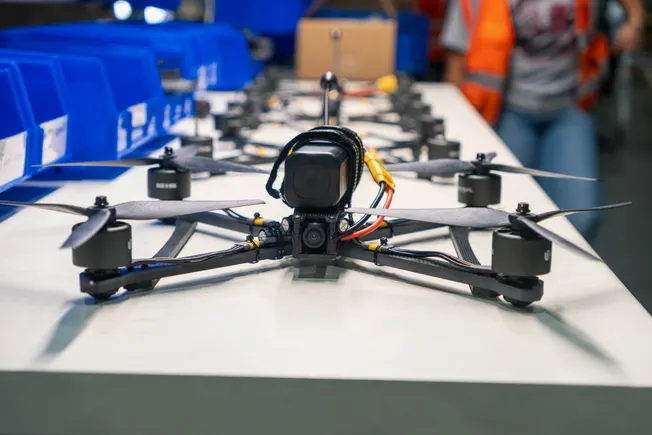
Powerus, a drone manufacturer co-founded by U.S. Army veteran Brett Velicovich, is entering the public market through a reverse merger with golf course company Aureus Greenway Holdings, and has received investment support from Trump's son and Unusual Machines. Its core goal is to address the shortcomings of the U.S. drone industry in large-scale manufacturing and supply chain autonomy.
Before joining the U.S. Army, Brett Velicovich attended the University of Houston, originally planning a career path in business, law, or medicine—the military was not on his radar.
Then 9/11 happened. Velicovich recalls thinking in his college apartment: "People hate us."
"That struck me," he said. "Why would people hate us enough to do something so terrible?"
Velicovich enlisted in 2004, planning to serve four years to "see what happens." He ended up serving eight years, "because it turned into a really cool adventure that I never could have imagined."
During his Army service, Velicovich served as a special operations intelligence analyst, deploying on seven overseas combat missions.
Among other experiences, this work exposed him to the world of drone technology. Velicovich recalls that his special operations unit used an expensive and very loud tactical drone.
"This technology was supposed to be able to scout the Taliban and Al Qaeda, but I thought, 'They'll hear it before we even get it close enough to them.'"
From then on, Velicovich began to "peel back the onion," diving deep into drone technology and its importance to warfighters on the ground.
"We will never fight another war without drone technology," he said. "It is so deeply integrated into everything we do."
Most recently, Velicovich co-founded drone manufacturer Powerus. The company is merging with golf course company Aureus Greenway Holdings and has receivedthe support of President Donald Trump's sons, Eric and Donald Jr.According to Investopedia, this deal is areverse merger or reverse takeover, which allows a private company to take control of a public company without an initial public offering, and it can be completed faster and at a lower cost.
Velicovich said the pending deal is "a classic reverse merger mechanism, leveraging an existing public vehicle that already has strong investor support, which works well for us."
Other investors include drone parts maker Unusual Machines, in which Donald Jr. is a shareholder and serves on theUnusual Machines advisory board. In June, Unusual Machinesinvested $30 million in Powerus, aiming to build a domestic "defense autonomy" supply chain. However, according to the press release, Powerus is not obligated to purchase any specific quantity of parts.
Manufacturing Dive spoke with Velicovich via Zoom and email about the drone industry and Powerus's strategic goal of filling a gap in the drone end-market.
The following interview has been edited for clarity and brevity.
MANUFACTURING DIVE: How did your Army experience help you in your role at Powerus?
BRETT VELICOVICH:It really comes down to understanding what the warfighter needs, what the end user needs.
All my experience and everything I do stems from an understanding of tactical warfighter operations. I think that's what sets us apart. The founders of the company all met in Ukraine. I was there a few days after the full-scale invasion began. I initially went to do humanitarian work. Then, because of the massive use of drones by Ukrainians, it evolved into big projects related to drones.
I saw the full spectrum of how this technology is used. I initially used it in the military to kill the enemy, and after I left the military, I used it for humanitarian work, wildlife protection, detecting roadside bombs, and many other ways people don't think about that help and save lives. All of that is integrated into everything we do at the company.

I've seen too much failed American technology. Many defense companies tried to sell their systems to Ukrainians, and most of them failed miserably. That was a wake-up call for us, realizing that American soldiers have a lot of technology that doesn't work, or they don't know it doesn't work. Ukraine is like the best testing ground for drone technology in the world, so a lot of what we do is with that background in mind: Would I, as a soldier, want to use these systems myself? Because a lot of times, you only get one chance to save a life.
Why start Powerus? What is missing in the drone industry, or what problem are you hoping to solve with Powerus?
It comes down to the scale and speed of drone manufacturing. In the U.S., people get excited when a defense contractor can build 100 drones a month, but that's not the reality of how we fight.
I went to a Ukrainian drone facility that was building 125,000 FPV drones a month. That was just one facility, and they have facilities all over the country. What Ukrainian drone manufacturers are doing, Russia is doing, and China is doing. In the U.S., you can't find a company producing 50,000 or 100,000 drones a month. That's a major problem.
I think, in terms of scale and speed of manufacturing, we need to completely overhaul the entire U.S. industrial base to be ready for that kind of fight. Right now, it's unsustainable. The math doesn't work.
I look at the drone industry a lot like the automotive industry. We need large manufacturers producing thousands of these a month, and there's plenty of room for different companies. It doesn't need to be one company; there can be many companies involved, so that's an important thing.
Another thing I saw, for example with interceptors, we were basically ready before the Iran conflict broke out. We knew that was one of the main mechanisms Ukrainians were using to shoot down targets.
Interceptors are very new in the U.S., but they've been operating in Ukraine for at least a year or two. We saw that trend, so we developed our own system that can also be produced at scale, because it ultimately comes down to a math problem. We shouldn't be shooting down a $20,000 drone with a million-dollar missile. We should be shooting down a $20,000 drone with a $5,000 interceptor. That gives you much better operational effectiveness, and these things can be mass-produced.
Why merge Powerus with golf course company Aureus Greenway Holdings instead of another drone company? What's the strategy behind that?
We really wanted to provide access to retail investors and the public, to give them the ability to invest in a company at the forefront of drone technology. There are many drone companies funded by venture capital and private investors, which doesn't give the average person the opportunity to participate in the AI and drone boom.
The goal is to give people access to us, to be able to invest in us, understand our vision, and let everyone come along with us, rather than companies that never go public, or that you never really hear about except for big investments behind the scenes. The average investor on Robinhood or E-Trade typically can't access these types of companies. Now, they can.
At the same time, we build heavy-lift drones for use in agriculture. We have a major customer, and we're using drones for crop spraying, replacing traditional crop-duster aircraft overseas. So, this technology can also be applied to golf courses.
What obstacles is Powerus currently facing? How is it overcoming or adjusting to maintain production?
For us, it's all about the supply chain. Whoever owns the supply chain will own this industry, because there's a limited number of motors and frames that can be produced, so our focus is on getting that right. It takes time, but there also need to be contracts that support the supply chain. We need more Replicator initiatives, more billion-dollar programs to get companies to produce these things at scale.
So our focus right now is on streamlining the process. When we win a Replicator project, and they say, "Okay, we want to order 50,000," what's the next step? Because when you peel back the supply chains of many companies, you find that many links still trace back to China, even down to the mineral level.
The focus is on making everything American-made and NDAA-compliant, and the problem is precisely that they can't get certain American-made things.
So I'm always thinking about the supply chain, and I think whoever truly owns it will win, because when you look at the competitors in the Replicator program, many of them are still sourcing from the same manufacturers. Whether it's flight controllers or motors, when you peel it back, you find there are actually only a few manufacturers producing these things, and you'll find many drone companies are using the same manufacturer's products, so that's one of the problems we're all trying to solve.
The Fiscal Year 2026 National Defense Authorization Act updated manufacturing requirements, banning the Department of Defense from procuring weapons and support system batteries made withmaterials from foreign entities of concern(such asChina or Russia) starting January 1, 2028. What are your thoughts on that?
Every year, they're raising the bar, and that's good. You need to force these people to do it. I like that. The first thing I did after I left the military to make money was sell DJI drones. I was selling Chinese DJI drones, so I understand DJI and how a Chinese company can strangle the commercial sector. There was a time when about 86% of drones sold in the U.S. were Chinese DJI drones, and initially, nobody cared. Then it got out of control, and we had to take the market back. Everyone needs a systemic shock to fix this, and it needs funding, and we're starting to see that across various departments, which is good.
Is Powerus investing in advanced technologies, such as automation and robotics, in its manufacturing operations? If so, what technology is being implemented, and how is it impacting the company's manufacturing operations?
Powerus is investing in advanced manufacturing technologies, including automation, digital production processes, and robotics, where they improve throughput, quality, and repeatability. The goal is not to replace people—it's to achieve faster scaling, more consistent production, and reduce bottlenecks in critical manufacturing steps.
What talent issues and gaps is Powerus and the drone industry facing? How is Powerus addressing them? Also, what policies or initiatives does the industry need to develop the workforce?
Like much of the drone and defense industrial base, the biggest constraints are experienced engineering talent, advanced manufacturing labor, and workers who can operate in regulated environments. Powerus is addressing this through internal training, partnerships, and building processes that accelerate onboarding and increase productivity. More broadly, the industry would benefit from workforce development programs focused on engineering, skilled trades, and pathways into defense manufacturing.
There has been criticism that President Donald Trump's sons, Donald Jr. and Eric, supporting the Powerus/Aureus merger is a conflict of interest. How and why do their contributions affect business and operations?
Soldiers don't care who is on the investor list—they need equipment that works. The involvement of external investors or supporters does not impact day-to-day operations, manufacturing decisions, customer execution, or governance processes. Powerus remains focused on execution, customer outcomes, and building long-term industrial capability. Strategic support is evaluated based on whether it helps accelerate growth and strengthen the business.