
Experts say FCC ban on foreign robots is actually a nearshoring strategy
The U.S. Federal Communications Commission (FCC) updated its covered list on July 28, banning the import and sale of foreign-made mobile robots and connected power inverters, sparking heated discussion among experts. Some experts believe this move aims to boost domestic robot production, but others worry it may affect allies and impact the supply chain.
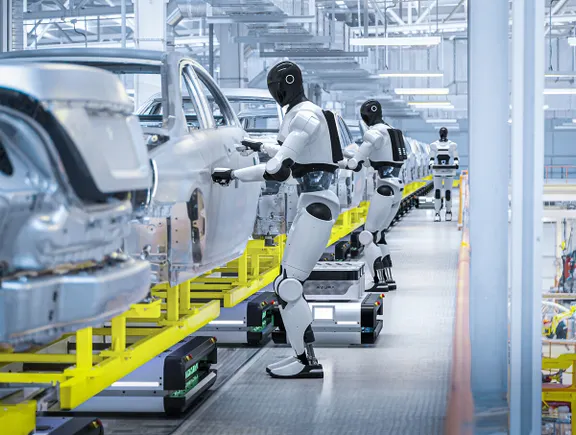
After the Trump administration decided last week to ban imports of advanced industrial robots from all countries outside the United States, experts had mixed views on the outcome, but ultimately expressed support from a supply chain perspective for the potential impact.
The Federal Communications Commission (FCC) updated itsCovered Liston July 28, adding imports of humanoid robots, mobile robots such as quadruped robots, and networked power inverters, citing national security risks.
Products meeting these definitions will no longer receive FCC equipment authorization and may not be imported, marketed, or sold in the United States, effectively amounting to a ban. Affected companies may apply forconditional approval。
This broad measure, effective immediately, comes amid growing concerns that China is using equipment assembled in the country to surveil customers and gain access to sensitive global data. However, the move also appears aimed at addressing another issue—the United States lagging behind globally in robot production and deployment.
"Domestically, we need help," said Robert Little, former head of robotics strategy at Novanta and a business development consultant.
At first glance, Little believed the move was necessary for cybersecurity reasons. But after studying the FCC's similar actions on drones and drone components, he said the recent ban is also a mechanism to boost domestic production of humanoid and mobile robots, as well as a means to incentivize foreign suppliers to establish supply chains in the United States.
"That's the ultimate goal," Little said, "and I think it can work."
In terms of investor capital, the United States is considered one of the global leaders in robotics, thanks to a surge in interest in artificial intelligence, foundational model research, and robotic systems. According toSilicon Valley Roboticsdata, US-based companies such as Figure AI, Agility Robotics, and Tesla captured 52% of the $9.4 billion in global venture capital last year.
However, the gap between the number of robots manufactured by US companies and their Chinese competitors is widening. According tothe International Federation of Roboticsdata, China installed 295,000 robots in 2024, accounting for more than half of the global market share. While preliminary data for China in 2025 has not yet been released, the organization estimates its installations are about ten times that of the United States.
In other words, "the US leads the world in where robotics is going... but is losing the race in current robot shipments," Silicon Valley Robotics said in its 2026 report.
To address this issue, the Association for Advancing Automation has urged Congress to consider adopting aNational Robotics Strategy, including subsidies, tax incentives, and other measures to drive domestic adoption and production of robots in the United States.
Little said the FCC's move applies only to new products, creating room for domestic companies to improve their competitiveness. If the restrictions are lifted in the coming years, "they will be in a stronger position."
Erik Nieves, founder and CEO of Plus One Robotics, said he anticipated the Trump administration would impose restrictions on Chinese robots, but was surprised by the breadth of the FCC ban. The move targets not only China but also affects robots from all other countries, including trading partners such as Japan, Germany, and South Korea.
"We would have preferred to see it more targeted, but you can't control what the government does," Nieves said. "If every action is an overreaction, then this is one."
He also noted that the impact of the ban depends on the complexity of the US Department of Defense's conditional approvals. Nieves said the details of the exemption process are unclear, adding that if it is not a simple check, the United States could "overly restrict partners we don't intend to treat that way."
Some believe the ban does not go far enough. In a recentLinkedIn post, Evan Beard, CEO of Standard Bots, said fixed industrial robotic arms should be included on the FCC's Covered List because, similar to mobile robots, they have networked, sensing, and actuation systems and pose security risks.
"If you can't trust the components, you can't trust the robot," he wrote. Standard Bots, headquartered in Glen Cove, New York, claims to be the largest US manufacturer of AI-native industrial robots, focusing on robotic arms.
The FCC update is expected to have minimal impact on digital transformation goals in manufacturing. Little said the market for humanoid and quadruped robots is still very young, and most US manufacturers are aware of the risks of buying Chinese products.
Last year, security researchers discovered an apparent "backdoor" onUnitree Robotics' Go1 robot dog. Recently, cybersecurity firm Vulncheck found that at least20 Zbtlink router modelshave hidden pathways for unauthorized user access to systems.
Autonomous mobile robots (AMRs) are a different matter. These robots are widely used in warehouses to move objects from one place to another. Little said US companies are using AMRs from China and Europe, partly because it is cheaper to buy from abroad.
He said there will be some disruption in the AMR market. But the ban only affects new products from other companies, not mobile robots that currently hold FCC licenses.
"They can continue selling older models while perhaps opening manufacturing centers in the US," Little said. "But if they think 'it's not worth it,' they'll keep selling older models, and the US won't get the new ones."
Whether the current administration will expand restrictions on robots manufactured in other countries remains to be seen. Earlier this week, Chinatightened exports of drones to the United Statesand sanctioned several US companies in retaliation for the FCC update.
Nieves said he would not be surprised if the government directs more grants and funding to strengthen the domestic robotics supply chain. Meanwhile, legislation to ban all Chinese robots is making progress in thenext National Defense Authorization Act.
"If there are security concerns, you have to take them seriously," Nieves said of the FCC update. "If buying robots from China somehow puts us at risk, then maybe we don't need to do that. But I don't want to see any domestic industry become complacent because they don't have to worry about innovation from Germany, Japan, South Korea, or anywhere else."